Horizon Europe Programme Structure
July 15, 2025
Horizon Europe (HE) is the European Union's flagship funding program for research and innovation, running from 2021 to 2027 with a total budget of €95.5 billion.
Key objectives of Horizon Europe
Horizon Europe's overarching goals are to strengthen the EU's scientific and technological bases and the European Research Area (ERA), boost Europe's innovation capacity, competitiveness, and job market, deliver on citizens' priorities, and sustain and support socio-economic development.
These contribute simultaneously to the Green Transition, Digital Transformation, and building a more resilient Europe as key strategic priorities. At the same time, the impact of HE will help tackle climate change and achieve the UN's Sustainable Development Goals (SDGs) by fostering open science practices and encouraging international cooperation. The programme is designed with synergies and complementarities between its various Pillars to maximise its overall impact, aiming for significant scientific breakthroughs, technological advancements, job creation, and effective solutions to pressing global challenges.
This guide breaks down the structure and key components of the Horizon Europe programme, helping you navigate its opportunities.
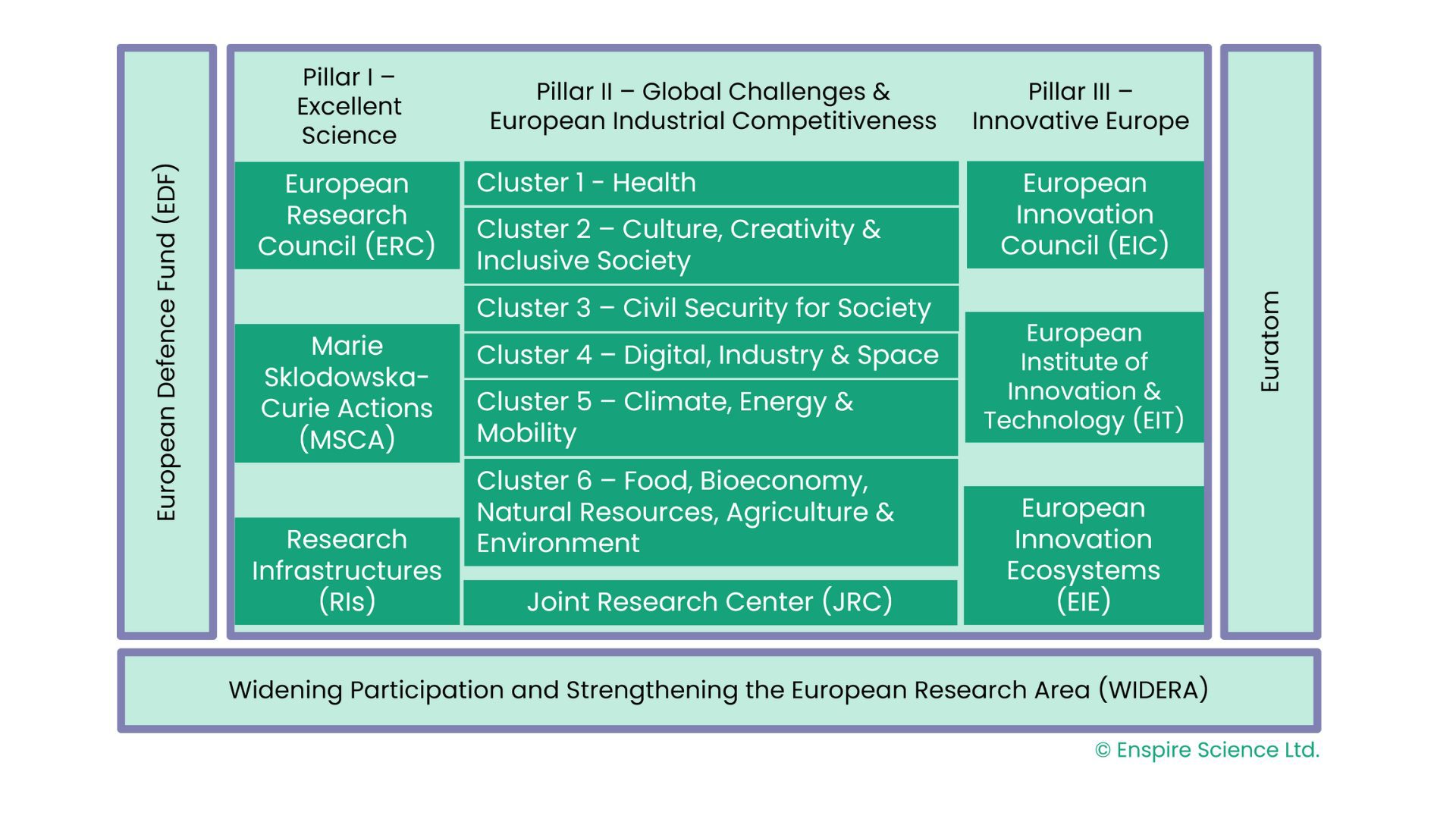
Horizon Europe is composed of three pillars with a specific focus on civil applications:
- Pillar I - Excellent Science;
- Pillar II - Global Challenges and European Industrial Competitiveness;
- Pillar III - Innovative Europe.
Additionally, there are three complementary parts:
- Widening participation and strengthening the European research area (WIDERA): Supporting R&I excellence in less advanced countries
- European Defence Fund (EDF): Exclusively focused on defence R&I
- Euratom: Supporting nuclear research and innovation
The three main Pillars of Horizon Europe
Pillar I: Excellent Science
This pillar aims to reinforce and extend the excellence of the EU's science base. It includes three funding schemes as detailed below:
European Research Council (ERC)
With a budget of €16 billion, the ERC supports investigator-driven, groundbreaking, high-risk, high-gain frontier research across all fields.
The ERC offers the following core grant schemes:
- ERC Starting Grant - Up to €1.5 million over 5 years for early-career researchers (2-7 years post-PhD)
- ERC Consolidator Grant - Up to €2 million over 5 years for researchers (7-12 years post-PhD)
- ERC Advanced Grant - Up to €2.5 million over 5 years for established researchers with an excellent scientific track record of recognised achievements.
- ERC Synergy Grant - Up to €10 million over 6 years for groups of 2-4 researchers tackling ambitious scientific problems.
- ERC Proof of Concept (PoC) Grant - up to €150,000 for a period of 18 months to explore the commercial potential of ERC-funded research.
For more information on the ERC and how to write a winning ERC grant application, click here.
Marie Skłodowska-Curie Actions (MSCA)
With a budget of €6.6 billion, the MSCA is the EU's flagship program for doctoral and postdoctoral training of researchers. It aims to equip researchers with new knowledge and skills through excellent training, international mobility, and interdisciplinary experiences.
The main funding programmes under MSCA are:
- MSCA Doctoral Networks - Collaborative training programmes for doctoral candidates, implemented by partnerships of universities, research institutions, and non-academic organisations. These networks aim to train highly skilled doctoral candidates who can face current and future challenges and convert knowledge and ideas into products and services for economic and social benefit.
- MSCA Postdoctoral Fellowships - aim to enhance the creative and innovative potential of PhD-holding researchers through advanced training and international mobility. If you're unsure whether you're eligible for this grant, click here for our eligibility calculator.
- MSCA Staff Exchanges - International, inter-sectoral, and interdisciplinary collaboration through exchanges of staff involved in R&I activities between academic and non-academic organisations based in Europe and beyond.
- MSCA COFUND - Co-funding of new or existing regional, national, and international doctoral and post-doctoral programmes supporting excellent training and career development of researchers.
- MSCA and Citizens - a Europe-wide public outreach event to bring research and researchers closer to the public, mainly through the European Researchers' Night.
For more information on the MSCA and how to write a winning MSCA grant application, click here.
Research Infrastructures (RIs)
Research Infrastructures are facilities that provide resources and services for the research communities to conduct research and foster innovation in their fields. They can be single-sited, distributed, or virtual. These include major equipment or sets of instruments, knowledge-related facilities, archives, scientific data infrastructures, computing systems, and communication networks.
With a budget of €2.4 billion, the Research Infrastructures Programme aims to provide the European research community with world-class and accessible research infrastructures. Projects funded under this programme support the development, upgrading and consolidation of excellent pan-European RIs, while optimisting their use to address major scientific and societal challenges.
Pillar II: Global Challenges and European Industrial Competitiveness
This pillar aims to boost key technologies and solutions underpinning EU policies and UN Sustainable Development Goals. It is composed of 6 clusters and the Joint Research Center (JRC), and has a total budget of €53.5 billion.
Clusters
- Health - €8.246 billion to advance citizen health and well-being through new knowledge, innovative solutions, and gender-sensitive approaches to prevent, diagnose, monitor, treat, and cure diseases.
- Culture, Creativity & Inclusive Society - €2.280 billion to strengthen European democratic values and rights, protect cultural heritage, and foster inclusive socio-economic growth.
- Civil Security for Society - €1.596 billion to address persistent security threats, including cybercrime, and natural/man-made disasters.
- Digital, Industry & Space - €15.349 billion to build a competitive, digital, low-carbon, and circular industry, ensure sustainable resource supply, develop advanced materials, and drive innovation for societal challenges.
- Climate, Energy & Mobility - €15.123 billion to combat climate change by understanding its dynamics and making energy and transport more climate-friendly, efficient, competitive, smart, safe, and resilient.
- Food, Bioeconomy, Natural Resources, Agriculture & Environment - €8.952 billion to reduce environmental degradation, reverse biodiversity and land/water decline, and improve natural resource management through transformative economic and societal changes in urban and rural areas.
Joint Research Centre (JRC)
The JRC is the European Commission's science and knowledge service, which employs scientists to carry out research to provide scientific advice and support to EU policy. The aim of this center is to generate high-quality scientific evidence for good public policies, and it has a budget of €1.970 billion. The JRC provides EU policies with independent scientific evidence and technical support throughout the policy cycle, offering scientific expertise and competences from a very wide range of scientific disciplines in support of almost all EU policy areas.
Pillar III: Innovative Europe
This pillar aims to stimulate market-creating breakthroughs and ecosystems conducive to innovation. It includes the following funding schemes:
European Innovation Council (EIC)
With a budget of €10.1 billion, the European Innovation Council's primary goal is to identify, develop, and scale up groundbreaking technologies and innovations, particularly those with the potential to create new markets and drive economic growth across Europe. The EIC focuses on high-risk, high-impact innovations, supporting them from the early stages of research through to market deployment and scaling up of startups and SMEs.
The EIC offers funding through 3 main instruments, each following either open (in any field of science and technology) or challenge-driven (referring to pre-defined topics) calls:
- EIC Pathfinder - funds radically new, high-risk and high-gain technologies through R&I grants from early-stage technology and research to proof of concept (TRL 1-4).
- EIC Transition - funds projects focusing on maturing and validating novel technologies in relevant application environments (TRL 5-8) until a pre-commercial stage. EIC Transition is restricted to proposals based on results generated by projects funded under the following funding schemes: EIC Pathfinder, FET, ERC, RIA in H2020, and European Defence Fund (EDF).
- EIC Accelerator - supports individual SMEs and start-ups to develop and scale up breakthrough innovations with high risk and high impact, from pre-commercial stages to market and scale-up stages. It provides funding through a combination of grants for innovation development costs and investments (via EIC fund) for market deployment and scale-up.
For more information on the EIC and how to write a winning EIC grant application, click here.
European Institute of Innovation and Technology (EIT)
The EIT aims to increase collaboration between education and research organisations, businesses, public authorities, and civil society. These partnerships should find and commercialise solutions to global challenges in ecosystems called EIT Knowledge and Innovation Communities (KICs). To help tackle these global challenges, the EIT offers students, innovators, and entrepreneurs a range of entrepreneurial educational courses, business creation and acceleration services, and innovation-driven research projects.
European Innovation Ecosystems (EIE)
The EIE acts in complement and synergy with the EIC and the EIT and innovative activities across Horizon Europe and other EU funding programmes to improve the overall ecosystem for innovation in Europe. It contributes to all 3 key strategic orientations of the Horizon Europe strategic plan (Green transition, Digital transition, and a more resilient, competitive, inclusive, and democratic Europe) and supports the New European Innovation Agenda. It builds interconnected, inclusive innovation ecosystems across Europe by drawing on the existing strengths of national, regional, and local ecosystems and pulling in new, less well-represented actors and territories to set, undertake, and achieve collective ambitions towards challenges for the benefit of society, including the green, digital, and social transitions.
Conclusion
The Horizon Europe programme provides a comprehensive framework for researchers, innovators, and institutions seeking to drive scientific excellence, tackle global challenges, and strengthen Europe's position in the global innovation landscape. Enspire Science offers support in finding the right opportunities, as well as training and consulting on all main funding schemes within the program. Contact us here to learn more.
Search our articles
Discover our EU grants knowledge base
Subscribe to our newsletter
GDPR: This form collects your name and email address. Read our privacy policy
Contact
Rua de Camões 437 - Escritório 202, 4000-147 Porto Portugal
Follow our EU grant conversation
Recent Posts
© All rights reserved.